Towards a Deterministic Vertical AGI for Energy Systems
A study of how to represent the energy sector in a world model and use its data and rules to make decisions.
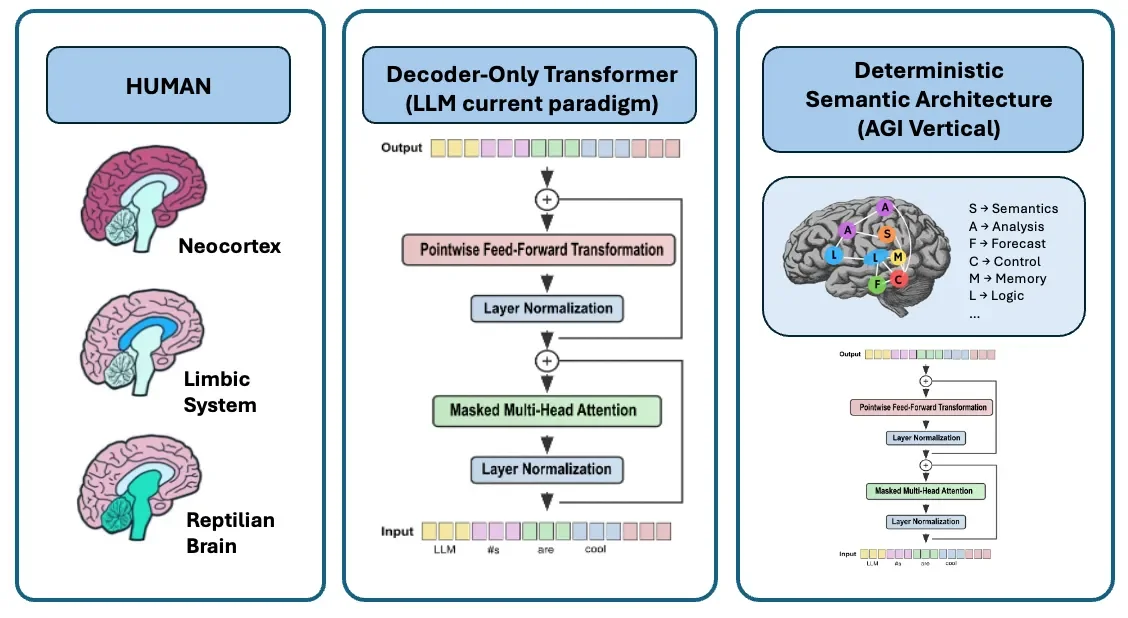
Artificial General Intelligence (AGI) has advanced strongly in the last decade, especially thanks to large language models (LLMs). However, when applied to critical infrastructures like energy, its most well-known characteristics —probabilistic responses, opaque reasoning, and absence of regulatory guarantees— cease to be virtues and become risks.
This work proposes an alternative path: a vertical, deterministic AGI specific to energy, built on three components defined in our patents: the Global Energy World Model (GEWM), the Tokenized Energy Profiles (TEP), and the Deterministic Semantic Engine (DSE). Together they transform the idea of intelligence: from generating plausible text to governing a domain under explicit rules, traceable operations, and verifiable data.
1. A different starting point
In recent years, AI has demonstrated surprising capabilities in text generation, translation, and automation. But in critical sectors, intelligence cannot be measured by its ability to "convince". It must mean certainty, compliance, and resilience.
Here lies the contribution of this work: if the first patent managed to unify scattered data into a coherent system, this second step goes further. It places determinism at the core, ensuring that the energy system is not only integrated but also governed under rules that can be verified, audited, and certified.
2. The three pillars
1. Global Energy World Model (GEWM)
Integrates physical laws, tariffs, and regulatory frameworks. Always versioned, always verifiable. Where probabilistic models "assume" rules, the GEWM enforces them.
2. Tokenized Energy Profiles (TEP)
Minimal, anonymous, and signed units of energy data. Each TEP ensures privacy and enables reproducible analysis. Against generic AI, which consumes personal data without guarantees, TEPs protect the user while increasing precision.
3. Deterministic Semantic Engine (DSE)
The semantic core that converts norms into exact calculations, leaving complete traceability of each decision. No "prompt lottery", no random variations: only reproducible, law-compliant results.
3. Why determinism matters
Imagine a local energy community. With a probabilistic model, the distribution of surpluses or compensation for shared energy can vary in each execution. Scenarios could even appear that violate technical or regulatory norms.
With our deterministic architecture, the result is always the same, always traceable, and always legal. The system offers the trust of a human auditor with the efficiency of total automation.
4. Built-in governance
This framework doesn't just calculate: it also measures its own reliability. Metrics like determinism rate, traceability coverage, or regulatory compliance tests provide objective evidence of compliance. In pilot tests, these values consistently exceeded 98%, demonstrating viability for critical infrastructures where there is no margin for error.
5. Beyond technology: a new trust contract
Generalist AGI pursues breadth and versatility, but usually does so by sacrificing transparency and accountability. Our proposal takes the opposite path: specialization, determinism, and alignment with governance.
In energy —and in any regulated sector— the true measure of intelligence is not how many tasks an AI can attempt, but how reliably it can govern under explicit and verifiable rules.
This is not just a technical contribution, but the foundation of a new contract between technology, society, and regulation: an AGI that strengthens trust instead of eroding it.
Conclusion
By embedding determinism, traceability, and regulatory compliance in the very core of calculation, we establish the first credible path toward a vertical AGI in energy.
Not an intelligence that "sounds good", but an intelligence that is correct, always, for everyone, and under any regulation.
You can consult the article here
Alejandro Díaz
Founder of TheryOS, business owner and entrepreneur in the energy and financial sectors.