Advanced RAG is not a world model
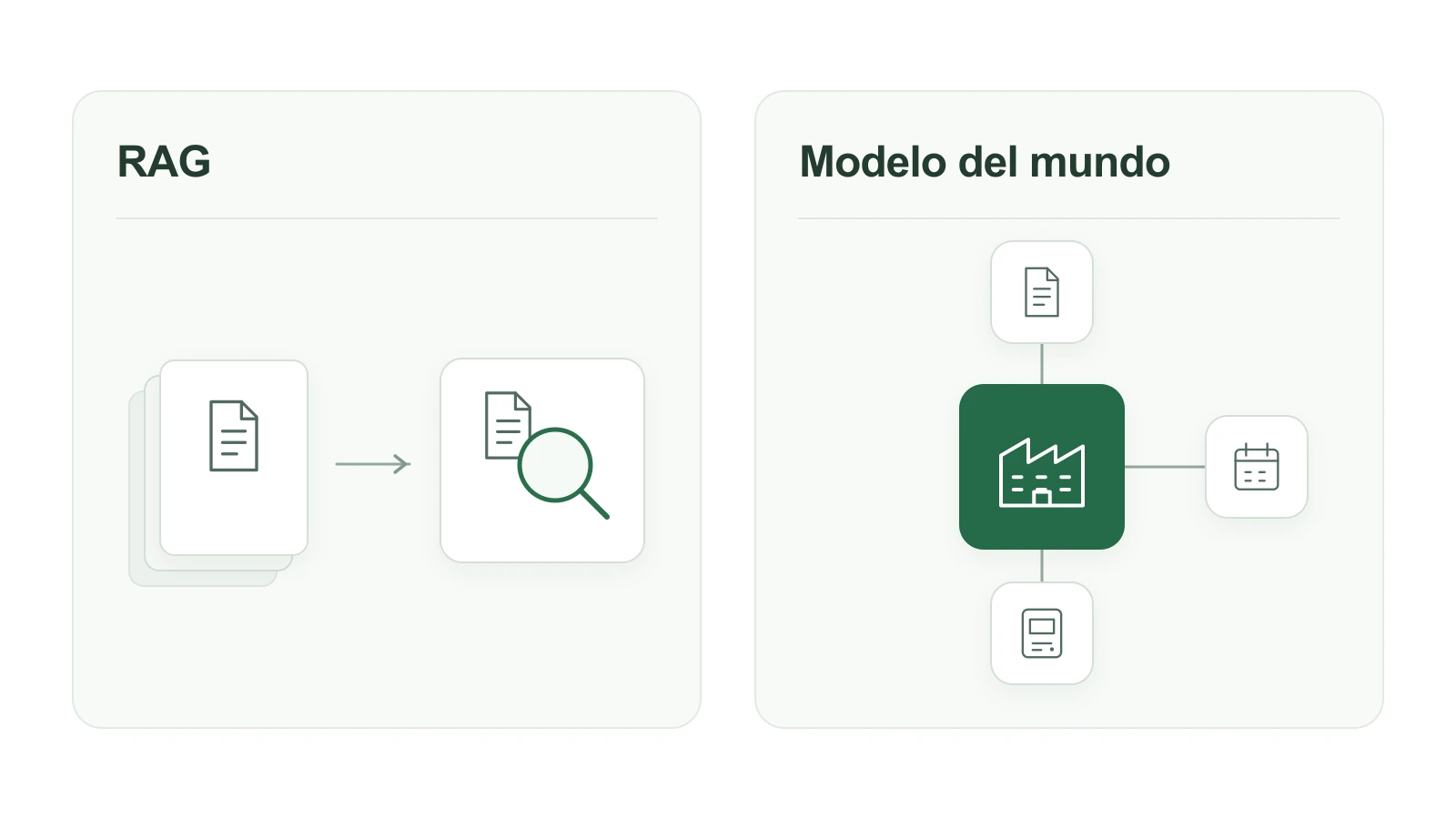
RAG helps find and connect documents. A decision requires linking that information to contracts, facilities and consequences.
Imagine a company asking its assistant whether it should change its electricity contract. The tool finds the bill, retrieves an offer and prepares an answer with citations. The result looks solid. Yet something decisive may still be missing: whether the offer applies to that supply point, whether the current contract has an exit fee or whether next year’s consumption will be similar.
This is the difference that interests me between retrieving information and representing a business. RAG has greatly improved the first task. Making a decision requires connecting what was found to the situation we want to act on.
What good retrieval brings
RAG is the name for combining a language model with a search mechanism. The system queries documentation and uses it to prepare its answer. That lets it work with information the model did not receive during training.
Advanced versions search in different ways, select excerpts more effectively and make use of relationships between entities. GraphRAG, for example, incorporates graph information to answer questions about a set of documents.
It would therefore be unfair to reduce RAG to keyword search. It can gather evidence, connect topics and provide a useful view of extensive documentation. Its contribution is especially valuable when finding and checking sources accounts for much of the work.
From the document to the facility
Let’s return to the electricity contract. Finding a price does not tell us which price applies. We need to link it to the supply point, billing period and version of the agreement that is still in force. If there are two offers, we need to know which one replaces the other.
A sector-specific world model aims to represent these relationships and, when it includes dynamic models, study how the facility might evolve. Here it is useful to distinguish two meanings of the term: organizing what we know about the business and anticipating the consequences of an action.
Research on World Models and Dreamer focuses on the second capability: learning a representation of the environment that allows possible futures to be explored. In energy, this idea must work alongside known rules, such as a contractual formula, and uncertain variables, such as future demand.
A comparison needs more than citations
To assess another tariff, I would apply both contracts to the same consumption. Then I would examine whether changing schedules affects the cost, whether production allows it and what that change costs. Each step answers a different question.
Retrieval helps gather the documents. Representation identifies what they refer to. Calculation compares prices. Forecasting studies consumption that has not happened yet. Confusing these roles can produce a well-documented answer that recommends an unsuitable option.
It also changes how we test the system: we need to see whether it finds the right document, understands whether it is still valid and revises its recommendation when a new condition appears.
How the two pieces fit together
In my work, RAG has a clear role as a way to access documentation and evidence. The world model provides the context needed to use them in a decision. They complement one another: a good representation needs sources, and a good search becomes more valuable when we know how the result fits.
The business step is moving from “this offer says this” to a comparison that explains what changes for that facility and why it is worth considering.
Related reading
References
Alejandro Díaz
Founder of TheryOS, business owner and entrepreneur in the energy and financial sectors.